
Yes. Plaque can stop growing, and with real lifestyle change it can shrink. But the most popular heart scan, the coronary artery calcium (CAC) score, often goes UP as plaque heals. If you want to see whether your hard work is paying off, the test you choose matters.
“My score went up. Did I do something wrong?”
A new patient of mine came in for the first time with a family history of early heart disease. He’d had a coronary artery calcium score before, a quick CT scan that measures calcium in the heart’s arteries. It showed some plaque, and he took it seriously. He changed his diet based on my advice, reduced stress, and increased his exercise. His cholesterol dropped a lot as expected.
A year later he had a second calcium score done elsewhere based on advice by his cardiologist. The number was significantly higher He sat across from me convinced he had failed.
He hadn’t. I’ve seen this many times, and it comes down to how the test works.
Why your calcium score can rise while you’re getting better
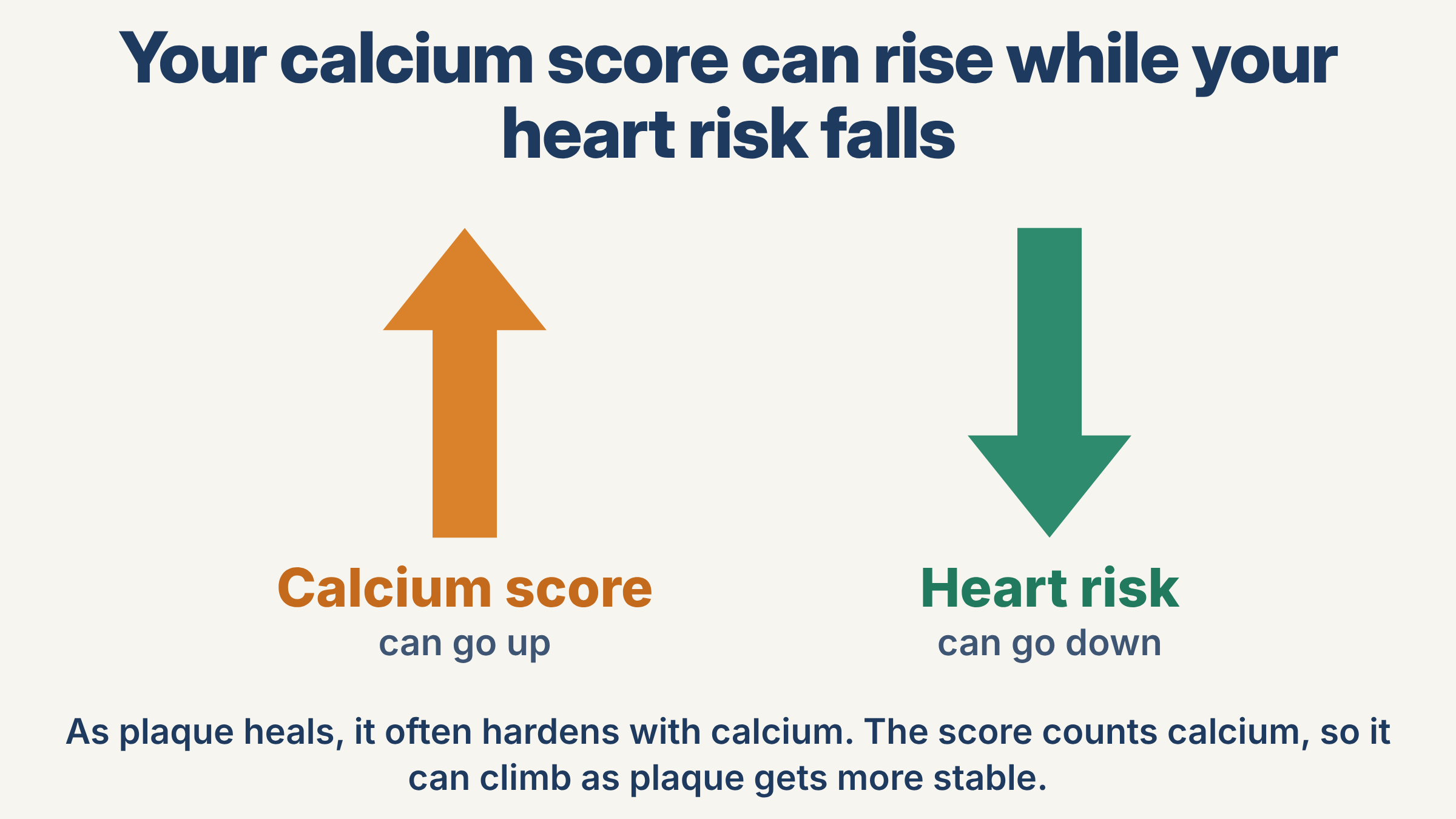
When plaque heals, it often hardens. Calcium is one way the body seals plaque and makes it more stable, less likely to rupture which cause heart attacks and strokes. The coronary artery calcium score measures that calcium, so the number can go up while your risk goes down, which can be quite confusing.
Several studies show this:
Statins raised artery calcium in every group studied, even when the plaque itself shrank (Journal of the American College of Cardiology, 2015).
The most active men had more calcium, but their plaque was more often the stable, fully hardened kind (Circulation, 2017).
Dense calcium is linked to lower risk, yet the standard score counts denser calcium as higher (JAMA, 2014).
This year’s national cholesterol guideline from the American College of Cardiology and American Heart Association (ACC/AHA) agrees:
“Once [cholesterol-lowering therapy] is initiated, repeat CAC [coronary artery calcium] testing is not indicated because statin therapy often increases CAC scores, even though they may stabilize or reduce plaque volume.”
Each calcium score also uses a small dose of radiation, about the same as a mammogram. Fewer than 1 in 10 people get an unexpected findings, such as a spot on the lung, that needs more testing, so multiple repeated calcium score tests over a lifetime adds unnecessary additional risk.
Who the calcium score is meant for
The 2026 ACC/AHA guidelines give the coronary artery calcium score a narrow job. It’s recommended for people at intermediate risk, and some at borderline risk, when it’s unclear whether to add cholesterol medicine to their lifestyle changes.
I use lifestyle change with everyone, from low risk to high. Some people at higher risk also need medication. For them, the guideline already recommends medication alongside lifestyle changes, so a calcium score doesn’t change the plan. For people at low risk, the guideline doesn’t use the score either. The score is not recommended at all for people with inherited (familial) high cholesterol.
A score of zero has limits too. The guideline says it shouldn’t be used to skip treatment in people with a strong family history of early heart disease, current smokers, or people with diabetes over age 40.
A zero score can also miss plaque. In a 16-year study of 2,673 adults whose calcium score was zero, more than a third had plaque in their neck arteries on ultrasound. That plaque predicted future heart disease, and it predicted who would later develop calcium.
My patients aren’t the people these studies were built on
The guideline’s advice on calcium scores comes mostly from large studies of the general public, such as MESA, which followed about 6,800 American adults, and from statin trials. Very few of those people were eating as healthy of a diet, exercising as much, or working on their stress reduction and sleep on as my average patient.
My patients are a smaller, more committed group. Many come to me because they want to do more than take a pill, and they follow through with our support.
In a study of nearly 22,000 men, the most active ones were more likely to have high calcium scores. Yet they were no more likely to die over the next ten years. A high score in a very active person may not mean what it means for everyone else.
No study I know of has compared calcium scores and ultrasound for tracking people like my patients. If someone did that study, I suspect ultrasound might move up the list to a higher guideline recommendation for screening and tracking. Until then, I think it’s the better fit for what my patients are doing: watching their arteries change over time, safely.
Why I use artery ultrasound instead
Ultrasound uses no radiation, so it’s safe to repeat. It can show soft plaque before it hardens, not just the calcified kind. And it lets us look at the same arteries year after year. The American Society of Echocardiography supports using carotid plaque on ultrasound to track artery disease over time.
It also predicts risk well. In a study of 5,808 adults, plaque seen on carotid ultrasound predicted heart attacks and strokes about as well as the coronary artery calcium score.
Many of the studies I reference used angiograms, which measure only the open channel inside the artery. As plaque builds, arteries stretch outward, so a large amount of plaque can sit in the wall while the channel looks close to normal. That means real change in the wall can show up as small numbers on an angiogram. Ultrasound measures the artery wall directly, down to hundredths of a millimeter, which makes it much better at picking up those changes.
It checks more than one place. In a study of about 4,200 healthy adults aged 40 to 54, plaque showed up more often in the leg arteries (44%) than in the neck (31%) or as heart calcium (18%). Our Dual and Complete screenings check both neck and legs.
Tracking also changes what people do. A Canadian clinic that adjusted treatment (lifestyle changes plus medication when needed) based on ultrasound results went from about half its patients getting worse to most of them improving. And in a trial of 3,500 adults, people shown pictures of their own plaque had better heart-risk scores a year later.
No test is perfect, and I’d love to see a better one come along for all of us. Until then, artery ultrasound is a good, safe way to see what’s happening and to track it.
What the guidelines say about ultrasound
ACC/AHA 2026: lists carotid ultrasound as an option to consider. It says plaque found there raises risk “even among patients with CAC [coronary artery calcium]=0,” and that starting cholesterol-lowering treatment is “encouraged” when plaque is present.
American Society of Echocardiography: recommends checking carotid plaque both for risk and for tracking over time.
European Society of Cardiology: calls carotid plaque on ultrasound a reasonable option when a calcium score isn’t available.
Why I don’t order calcium scores
For most of my patients, the real questions are how hard to push lifestyle changes and whether medication should be added. If an ultrasound already shows plaque, the guideline supports treatment (lifestyle changes plus medication if needed) no matter what the calcium score says. A calcium score wouldn’t change the plan, and a repeat score could rise and cause needless worry.
If you’ve already had one, bring it. It’s useful history, and we can build on it.
Plaque can reverse
Two doctors showed this years ago.
Dr. Caldwell Esselstyn at the Cleveland Clinic put patients with severe heart disease on a very low-fat, plant-based diet, plus cholesterol medicine. The goal was total cholesterol under 150. Every one of the 11 who stuck with it for about five and a half years got there, coming down from an average of 246. None of them got worse, 11 of their 25 narrowed spots opened up, and no one had a new heart attack. The five who quit and went back to their old diet reported 10 heart events. In a later group of 177 people who stayed with the diet, fewer than 1% had another heart event.
Dr. Dean Ornish ran a randomized trial with 48 heart patients, using lifestyle changes and no cholesterol medicine at all. Over five years, artery narrowing improved in the lifestyle group and got worse in the usual-care group. The lifestyle group had 25 heart events compared with 45 in the usual-care group.
I have seen this same pattern of reversal with many patients over my career which in addition to the above studies further supports the treatment strategies used at Aspen Health. Plaque build up along with stroke and heart attack risk doesn’t have to increase as you age like everybody else. You can do something about it. Take action. See your potential.
Getting your artery screening
Every screening at Aspen Health includes your report and a review of the results with me. If you’re a member, your results become part of your ongoing care. If you’re not, I’ll explain what the results show and offer some general next steps, and you can decide whether membership is a good fit.
— Jay Benson, DO
Founder, Aspen Health | Princeton, NJ
ReferencesEsselstyn CB, et al. J Fam Pract. 1995;41:560–8. PubMedEsselstyn CB, et al. J Fam Pract. 2014;63:356–64. PubMedOrnish D, et al. JAMA. 1998;280:2001–7. DOIGlagov S, et al. N Engl J Med. 1987;316:1371–5. DOIPuri R, et al. J Am Coll Cardiol. 2015;65:1273–82. DOIAengevaeren VL, et al. Circulation. 2017;136:138–48. DOICriqui MH, et al. JAMA. 2014;311:271–8. DOIBlumenthal RS, et al. 2026 ACC/AHA Dyslipidemia Guideline. DOIMehta A, et al. (MESA). Circ Cardiovasc Imaging. 2021;14:e011701. DOIYeboah J, et al. (MESA). JAMA. 2012;308:788–95. DOIDeFina LF, et al. JAMA Cardiol. 2019;4:174–81. DOIJohri AM, et al. ASE carotid plaque recommendations. J Am Soc Echocardiogr. 2020. PDFBaber U, et al. (BioImage). J Am Coll Cardiol. 2015;65:1065–74. DOIFernández-Friera L, et al. (PESA). Circulation. 2015;131:2104–13. DOISpence JD, Hackam DG. Stroke. 2010;41:1193–9. DOINäslund U, et al. (VIPVIZA). Lancet. 2019;393:133–42. DOI