
Protein advice is everywhere, and much of it conflicts. I want to lay out what the evidence actually shows, because it shapes how we approach nutrition at Aspen Health.
First, protein is a nutrient, not a food group. Dietary guidelines group "protein foods" together, and that's fine, but it's easy to hear "protein" and think "meat." Meat is only one source. Beans, lentils, tofu, nuts, seeds, whole grains, and even broccoli all carry some protein.
Protein has also become a marketing tool. It's printed on the front of cereal boxes, chips, and coffee, and protein powder is being added to just about everything. So is more protein better for you? Can too little hurt you? And what's the right amount for you?
Protein matters, and more as we age. But more isn't automatically better, and where it comes from matters as much as how much you eat.
How Much Do You Need?
The official recommendation for adults is 0.8 grams of protein per kilogram of body weight a day. That's the floor to prevent deficiency, not a target. For most women it works out to only about 45 to 55 grams a day, and for most men about 55 to 60. I recommend around 1.0 gram per kilogram per day for adults up to 59 and up to 1.2 grams per kilogram per day after 60, which is 25 to 50% above that minimum, and more in certain situations, based on the evidence for optimal intake.
I calculate from ideal body weight, meaning the weight your frame would carry in the healthy range for your height (around a BMI of 22). Body fat needs very little protein, so using your current weight while carrying extra pounds overshoots. A 5'6" woman at 230 pounds would get about 125 grams a day from her current weight, but 64 to 76 grams from a healthy weight for her height (135 pounds). That gap is about 200 extra calories a day.
You don't need to do the math. If you're a patient, we'll work out your exact number together. These ranges are for daily intake and cover most adults, assuming heights of about 5'2" to 5'8" for women and 5'8" to 6'2" for men:
Adults up to age 59 (1.0 g/kg): about 55 to 65 g for women, 65 to 80 g for men
Adults 60 and older (1.2 g/kg): about 65 to 80 g for women, 80 to 95 g for men
Very sick or losing muscle (up to 1.5 g/kg): up to about 100 g for women, 115 g for men
Lifting seriously (1.2 to 1.6 g/kg): about 65 to 105 g for women, 80 to 125 g for men
Pregnant or breastfeeding (about 1.1 g/kg): about 70 g
Children and teens: (1.0 g/kg ): Depends on their age/weight
Kidney disease: lower, set with your doctor
Most women need about 55 to 80 grams a day, and most men about 65 to 95, depending on age.
Why Too Little Is a Problem
Your body uses protein to build and repair muscle, bone, skin, antibodies, and the enzymes that run nearly everything else. If you run short, it shows up as weaker muscles and bones, slower healing, more infections, and the kind of tiredness people blame on age.
The evidence is strongest in older adults, who are also the most likely to fall short. Pooled data from several countries found about 1 in 5 adults over 55 eating less than the official minimum, and nearly half eating less than 1.0 gram per kilogram.
Muscle and mobility. In a study of about 2,000 adults in their 70s, those eating less than 0.7 grams per kilogram were 86% more likely to develop trouble walking or climbing stairs over six years than those eating 1.0 or more.
Frailty. In more than 27,000 UK adults over 50, those eating 1.2 grams per kilogram or more were 32% less likely to become frail than those under 0.8. Frailty here means weakness, exhaustion, slow walking, and unplanned weight loss.
Bones. International osteoporosis experts concluded that protein above the minimum is tied to slower bone loss and fewer hip fractures, as long as calcium intake is adequate.
Immunity and healing. Protein shortfall is a leading cause of weaker immune function in older adults, and wounds heal more slowly without enough of it.
Too little protein costs you muscle, bone, and resilience, especially after age 60.
Why Too Much Is a Problem
Past a point, more protein stops helping and starts costing you.
It turns into extra calories. A review of 49 trials found no further muscle gain past about 1.6 grams per kilogram, even with resistance training. Your body has no storage tank for extra protein. The nitrogen gets stripped off for your kidneys to clear, and the rest is burned or stored like any other calorie.
It crowds out what protects you. There's only so much room on your plate. Every extra chicken breast or shake replaces beans, whole grains, vegetables, fruit, or nuts, the foods carrying fiber, potassium, magnesium, and thousands of protective plant compounds. Meat, eggs, and dairy have no fiber. In a large set of reviews in The Lancet, people eating the most fiber had 15 to 30% lower rates of death, heart disease, stroke, type 2 diabetes, and colon cancer. Most Americans fall well short of the 25+ grams a day where the benefit was highest.
High-protein, low-carb diets don't hold up. Keto, Atkins, and carnivore diets take weight off early. Protein fills you up, cutting food groups cuts calories, and the first pounds are water. But in an early New England Journal of Medicine trial, the low-carb group's lead at six months was gone by one year, and a review of 121 trials found most diets' benefits faded by 12 months. LDL cholesterol can climb along the way. Over the long run, in a study pooling more than 430,000 people, low-carb eating built on meat and animal fat was linked to an 18% higher risk of death, while low-carb eating built on plants was linked to an 18% lower risk. Very high-carb diets did poorly too, likely more so when those carbs are refined. The lowest risk sat in the middle.
Past what your body can use, more protein adds calories, more long-term risk, and takes up room meant for other important nutrients.
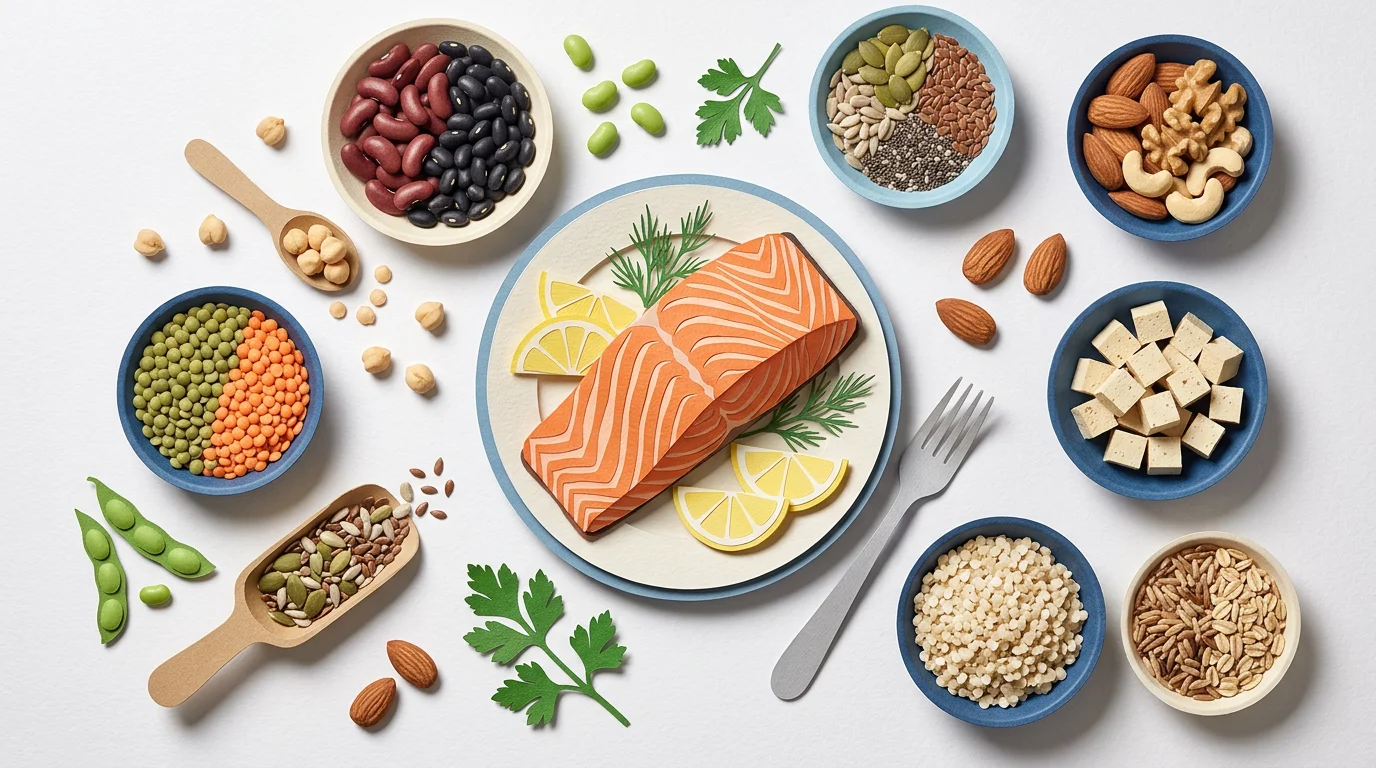
Where Your Protein Comes From Matters Most
I tell patients to aim for 70% or more of their protein from whole plant foods. The evidence keeps pointing that way.
Heart. The largest study of the plant-to-animal protein ratio, about 200,000 people over 30 years, found 19% lower cardiovascular disease and 27% lower coronary disease in those eating the most plant protein relative to animal. The benefit leveled off at the top but never reversed.
Longevity. In more than 131,000 health professionals, each 3% of calories from plant protein was tied to 10% lower risk of death. Swapping processed red meat for plant protein was tied to 34% lower risk.
Healthy aging. In nearly 49,000 women followed from midlife, more plant protein was tied to 38% higher odds of reaching old age free of major disease, with memory and physical function intact. For animal protein, the figure was 7%.
Frailty. In more than 85,000 older women, shifting 5% of calories from animal to plant protein was tied to 38% lower risk of becoming frail.
Diabetes. Across more than 600,000 people, swapping 20 grams of animal protein for plant protein was tied to 20% lower risk.
Diet modeling in older adults suggests that going past about two-thirds plant intake requires planning for vitamin B12, calcium, iodine, iron, and omega-3s. So 70%+ is my target, with those guardrails covered by careful food choices and, for some patients, supplements.
Build it from lentils, beans, chickpeas, tofu, tempeh, edamame, nuts, seeds, and whole grains. In trials, soy built muscle as well as milk protein did. Fill in with small servings of wild caught fish, organic poultry, or organic plain Greek yogurt, and keep red and processed meat rare. And, remember, a cookie with 15 grams of protein added is still a cookie.
Contaminants follow the source too. Chemicals like dioxins and PCBs collect in animal fat as they move up the food chain, which makes meat, dairy, poultry, and fish the main sources in our diet. Fish can also carry mercury. That's one more reason to meet your protein needs with whole plant foods first, and use only as much animal protein as you need to reach your goal.
Protein powders aren't off the hook, and plant-based ones are often worse. In a 2026 analysis of 30 protein supplements, every one contained at least one toxic metal, and plant-based powders averaged about three times the lead and five times the cadmium of dairy-based ones. Supplements aren't approved by the FDA before they're sold. If you use a powder, pick one with independent third-party testing for heavy metals, and treat it as a backup to real whole food, not a staple.
Source matters for your kidneys too. Chronic kidney disease affects about 14% of American adults and 1 in 3 over 65, and nearly 9 in 10 don't know they have it. Animal protein adds acid and phosphate load and pulls calcium into the urine. In one study, the same amount of protein from animal rather than plant sources raised urine calcium by nearly half and raised uric acid, increasing bone loss and stone formation risk.
Aim for 70% or more of your protein intake from whole plant foods.
Balance Is the Point
Too little protein costs you muscle, bone, and resilience. Too much, especially from animal sources, crowds out the foods protecting your heart, blood sugar, and kidneys, and adds more risk. Enough protein, mostly from plants, with nothing pushed to an extreme, gives you the most upside with the least downside.
In the office, we can calculate your number, check your labs, and plan how to eat to safely lose weight, gain muscle, and live more healthfully.
— Jay Benson, DO
Founder, Aspen Health | Princeton, NJ
Key References
Houston DK, et al. Protein Intake and Mobility Limitation in Community-Dwelling Older Adults: the Health ABC Study. Journal of the American Geriatrics Society, 2017.
Mendonça N, et al. Protein intake and transitions between frailty states in middle-aged and older adults: the UK Biobank. BMC Medicine, 2025.
Rizzoli R, et al. Benefits and safety of dietary protein for bone health: an expert consensus paper. Osteoporosis International, 2018.
Morton RW, et al. Effect of protein supplementation on resistance training-induced gains in muscle mass and strength. British Journal of Sports Medicine, 2018.
Reynolds A, et al. Carbohydrate quality and human health: a series of systematic reviews and meta-analyses. The Lancet, 2019.
Seidelmann SB, et al. Dietary carbohydrate intake and mortality: a prospective cohort study and meta-analysis. Lancet Public Health, 2018.
Glenn AJ, et al. Dietary plant-to-animal protein ratio and risk of cardiovascular disease in 3 prospective cohorts. American Journal of Clinical Nutrition, 2024.
Song M, et al. Association of Animal and Plant Protein Intake With All-Cause and Cause-Specific Mortality. JAMA Internal Medicine, 2016.
Ardisson Korat AV, et al. Dietary protein intake in midlife in relation to healthy aging: the Nurses' Health Study. American Journal of Clinical Nutrition, 2024.
Patandin S, et al. Dietary exposure to polychlorinated biphenyls and dioxins from infancy until adulthood: a comparison between breast-feeding, toddler, and long-term exposure. Environmental Health Perspectives, 1999.
Chen M, et al. Heavy Metal and Microplastic Exposure from Sports Protein Supplements: Integrated Health Risk Modeling and Scenario Analysis. Environmental Research, 2026.
Centers for Disease Control and Prevention. Chronic Kidney Disease in the United States. 2026.
Breslau NA, et al. Relationship of animal protein-rich diet to kidney stone formation and calcium metabolism. Journal of Clinical Endocrinology and Metabolism, 1988.